
The Institute
Breathe life into forgotten history.
Ajnadayn Institute exists to reconnect Muslims with their history, heritage, and intellectual tradition — rigorously, accessibly, and with deep respect for the sources.
Our Vision
To breathe life into forgotten history and reconnect a generation of Muslims with the depth and brilliance of their own civilisation.
Our Focus
Rigorous, accessible education in Islamic history and heritage — taught with scholarly care and grounded in primary sources, not nostalgia.
Our Principles
Academic integrity, intellectual honesty, and a deep respect for the tradition. We teach history as it was, with confidence and humility.
Ajnadayn Institute exists for a specific reason, and it is worth stating plainly.
Most English-speaking Muslims today grow up with a historical literacy that is, through no fault of their own, patchy. They know the basic outline of the sīrah. They know that there were caliphates, that something important happened in al-Andalus, that the Ottomans existed for a long time. Beyond that, the picture thins quickly. The Abbasid administrative state, the Fatimid century, the long Mamluk hold on Egypt, the intellectual life of seventeenth-century Damascus, the constitutional debates of late Mughal India — these tend to arrive, if they arrive at all, as scattered episodes rather than as a connected account. The result is a Muslim public that holds its past with great affection and limited detail.
We do not think this is anyone's personal failing. It is a structural problem. The English-language translation pipeline for the primary sources is thin. A great deal of the standard chronicle literature — Ibn Hayyan, al-Maqqari, the Padshah Nama, most of the Ottoman ulema of the eighteenth century — has either never been translated or exists in Victorian versions that no one updates. Where serious academic scholarship does exist, it sits behind university paywalls, written in a register that assumes the reader has already done a decade of Arabic, Persian, or Turkish coursework. And the children's-book end of the market, which is where most Muslim families first encounter their own history, is not designed to grow with the reader.
What is missing is the middle. There is a real hunger, among adult Muslims who have left the children's-book level behind, for teaching that is serious without being inaccessible — that assumes intelligence and curiosity but not a graduate degree. We meet these readers constantly. They are engineers and doctors and teachers and students. They want to read primary sources in good translation. They want to know why the historians they have heard of are worth reading, and which historians they have not heard of are worth reading. They want to be trusted with complexity.
This is the audience Ajnadayn is built for.
What we do
We teach Islamic history in small, live cohorts. A course runs for four to six weeks, meets weekly, and is capped at a size that lets the instructor know every student's name and every student's questions. The reading is real — primary sources in translation, supplemented by the best secondary scholarship we can find, with citations the student can follow up. The lectures assume a literate adult audience. The discussion sections assume that students have done the reading.
The cohorts cover specific subjects rather than general surveys. A course on the Abbasid translation movement. A course on the Andalusi historians. A course on the Crusader-Ayyubid Levant. A course on the Mughal chancery. This is deliberate. We have come to believe that a student who has read deeply in one period, with attention to the actual texts, learns more about how to think historically than one who has been walked through a thousand years at altitude.
Outside the cohort model, we publish essays — the kind you will find on this site — and book summaries that introduce works we think readers should know about but may not have time to read in full. The essays are not catechism. They are arguments, and like all arguments they are open to dispute.
What we are not
We are not a madrasah. We do not teach fiqh or ʿaqīdah. We do not certify scholars. There are excellent institutions for those purposes, run by people more qualified than we are, and we encourage students to seek them out.
We are also not an academic department. We do not award degrees. We do not pretend to peer review. Our instructors read the academic literature carefully and engage with it seriously, but the institute's purpose is to teach, not to credential.
What we are, more precisely, is a teaching project for the gap between those two things. The reader who has finished the introductory books, who has perhaps started Arabic, who wants to spend a serious season of life reading carefully through one period of Islamic history with someone who has done the work — that reader is who we are built for.
What to expect as a student
A reading list that is shorter than you might expect and harder than you might expect. Weekly sessions that assume you have done the reading and that move at the pace of an intelligent conversation rather than a lecture. Honesty about what the sources do and do not tell us. A willingness to leave questions open when the evidence does not settle them.
We will not promise that you will come away with a comprehensive grasp of Islamic history. Nobody has that. What we will say is that you will know one period of it well, you will know how to read the sources for that period, and you will know which questions to ask of the next period you study on your own.
That is the whole offer. We think it is worth your time. We are doing the work to make sure it is.
— Ustadh Maheer Hasan, Academic Director
The Institute
Our Team
Our team is made up of experienced, highly qualified instructors who specialise in a wide range of subjects.
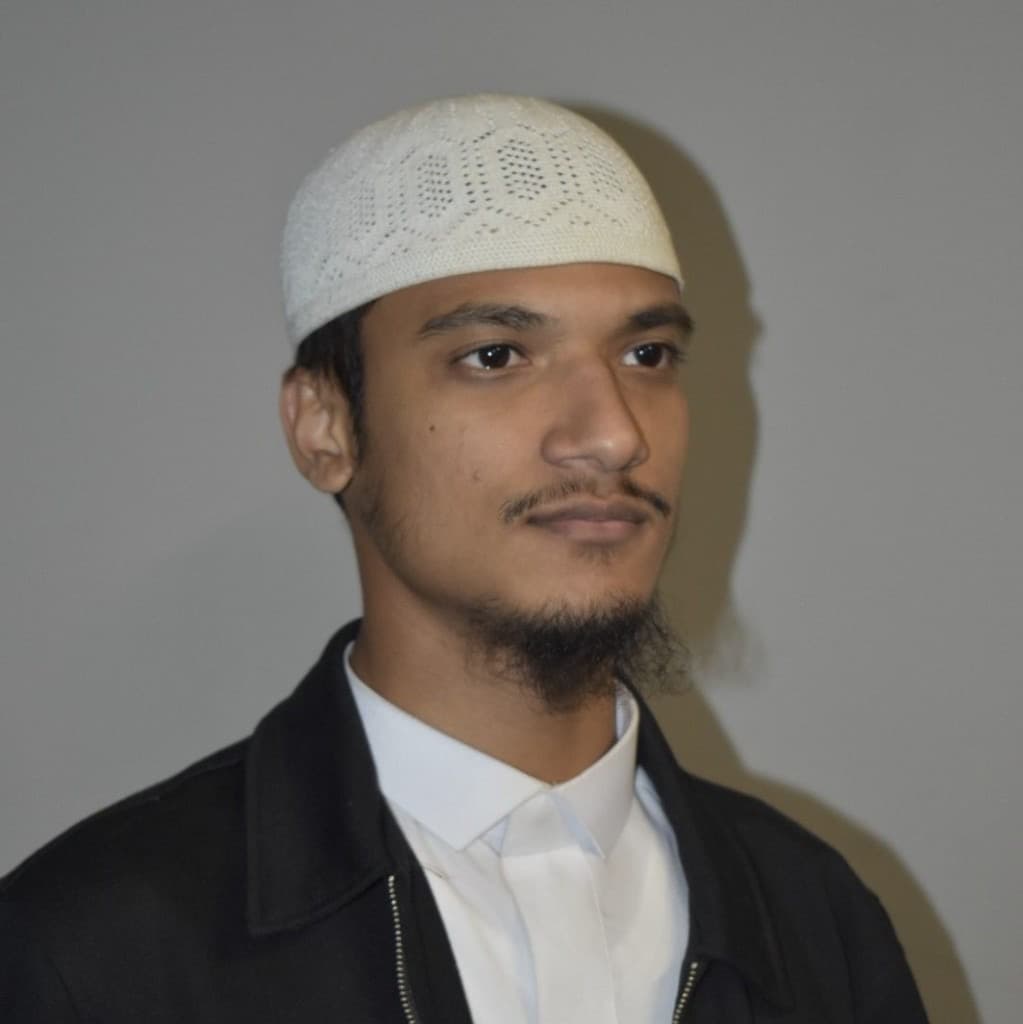
Ustadh Maheer Hasan
Founder & Academic Director
Ustadh Maheer is the founder of Ajnadayn Institute and serves as its academic director. He graduated with a BA in history and currently studies advanced Islamic sciences. He currently works as a history teacher and specialises in 15th century Ottoman military and political history.
Ustadh Maaz Hasan
Tutor
Ustadh Maaz is a graduate of Jamiatul Ummah and currently completing higher education alongside traditional Islamic studies.